
OUR SOCIAL CONTRACT
How the Small Business Administration has helped millions of communities and people.

Week of March 16, 2026
For those of you who are new to Our Social Contract: Welcome. For over a year, I have been writing this weekly column to shine a light on many of the federal services that make our lives better – even when we don’t know these agencies exist. For the generations of people born during and after Ronald Reagan’s presidency, the only government they have known is one that subsidizes the wealthy at the expense of everyone else.
For the generation born in the early years of this century, federal government seems more invested in fetuses than people who are actually living; focusing on gutting support for hunger relief, health care, environmental regulation, clean air and water, and making sure that corporations can continue to rob from the poor to pay more to the rich.
For new readers and those of you who have been with me since the beginning, there was a time that government seemed to actually pay attention to our problems and work to craft remedies. This column shows how it has worked on our behalf and what we are losing. Only when we know what is possible can we hope to reclaim it. And then, make our voices heard!
The Small Business Administration is there for the little guy.
I had my first encounter with the Small Business Administration (SBA) when I turned to the local office in my community for help with setting up my mediation practice. The SBA referred me to their partner, SCORE, the Service Corps of Retired Executives. SCORE received funding from the SBA and provided this mentoring service to help guide new entrepreneurs in establishing successful businesses. My SCORE mentor was invaluable in pointing me in directions for marketing, accounting and a myriad number of important, but often overlooked, matters. I was saved from making mistakes that could have tanked my new business from the start. This service was free. My tax dollars had already paid for this service.
I didn’t fully appreciate the magnitude of the SBA until I was hired by FEMA as a reservist for the newly formed Alternative Dispute Resolution (ADR) cadre. I would be sent, or deployed, to disaster areas to assist in resolving disputes between federal, state and local entities, staff and NGOs; basically, anyone who worked on disaster relief. My first deployment was to Joplin, Missouri, a city in the southwestern corner of the state in an area known as our country’s tornado alley.
As I became familiar with all the services being provided to survivors of disasters, I stumbled upon the SBA representatives in one of the disaster recovery units. I learned that the SBA didn’t just help small businesses develop: this agency also provided financial support to individuals, whether homeowners or renters, who either were uninsured or didn’t have enough insurance to repair or replace their dwellings and personal property. The support, in the form of low-interest loans, was immediately available to help a community get up and running again.
“Somebody might immediately, within hours, need to replace all their belongings, need to get a car, ” explained Isabel Casillas Guzman, the director of the SBA in 2024. “And so those immediate supports for renters and homeowners, [to] get that capital to get back to their lives, is what we’re there for.” SBA has been engaged in disaster response filling the marketplace gaps. (U.S. Chamber of Commerce, May 2024) Under Guzman, the SBA made significant changes to its assistance methods, addressing the real needs of communities and the small businesses destroyed by natural disasters.

What is a small business?
A small business is defined as having less than 500 employees. Yet there are many small businesses that don’t have any employees.
“Among the roughly 6 million small businesses with employees, 49% have just one to four workers, according to the latest estimates for 2021 from the Census Bureau’s Annual Business Survey. About a quarter (27%) have between five and 19 employees; 8% have 20 to 99; and just 1% have 100 to 499 workers. The remaining 14% had paid employees at some point during the year. Overall, small businesses employed an estimated 56.4 million workers in 2021 and brought in over $16.2 trillion in revenue, according to ABS data.” (Pew Research, May, 2024)
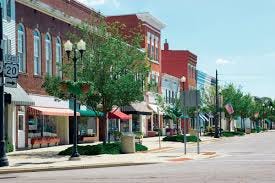
If you look around your community, you can probably identify the many small businesses that contribute to the health of your town. Whether it’s the local restaurant, the jewelry store, the dry cleaner, the liquor store, the hair salon you frequent or the gift store where you can find just the right item, these are the small businesses that help Main Street flourish. They are critical to providing services and revenue to your town. It is said that small businesses are the backbone of our economy.
A brief history of the SBA
The SBA is an outgrowth of the Reconstruction Finance Corporation (RFC), begun under President Hoover and placed under the purview of the Department of Commerce. Its original mission, necessitated by the Depression, was to provide loans to businesses, financial institutions and railroads, but its powers were later broadened to encompass agriculture plus local and state governments. During WWII it also helped support the war effort by providing funding for munitions and other factories contributing to the fight.
But investigations and hearings into the RFC showed that it tended to favor big corporations over the smaller business sector and was rife with corruption. President Eisenhower signed the legislation in 1953 that created the SBA, an independent agency whose focus was to provide low-interest loans to businesses, creating a revolving loan program so that repayment from one loan would be used to support the next business loan. With the creation of the SBA, the RFC was terminated.
Critical to the success of the SBA was that it stayed focused on small business development. “The fundamental purposes of the SBA are to protect the interests of small business, provide counseling to current or prospective business owners, and assist in government procurement to ensure that small businesses receive a fair share of government contracts and subcontracts.”
Over time, the agency added additional mandates to its work so that it now also “lends money to small businesses, state and local development companies, and victims of disasters or economic injury. It licenses, regulates, and lends money to small business investment companies.” (History of SBA)
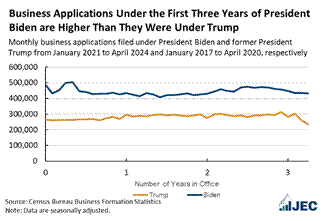
The SBA is a lifeline for many small business owners who would not otherwise qualify for loans through regular banking channels. Under President Biden, a record number of small business applications were filed and supported. The Biden administration’s policies heavily promoted business development in the traditionally underserved communities of color, recognizing that building businesses builds communities and improves lives.
“Since the start of the Biden-Harris Administration, there have been more than 20 million new business applications with an average of 441,453 filed each month – a rate over 91% faster than pre-pandemic averages. This historic Small Business Boom has been driven by women and people of color, with data showing Black business ownership doubling since 2019, Latino business ownership at the highest level on record, and the number of women-owned businesses is increasing at nearly twice the rate of male-owned businesses.”(SBA November 2024) The number of small business applications during the Biden presidency far exceeded the number of applications during Trump’s first term. Now, in his second term, small business applications are down and the ones arriving are tilted towards manufacturing.
What is happening to the SBA under Trump?
Trump continues to tout his business credentials. One could assume that he would support the work of the SBA. After all, the more businesses that are created, the better it is for our economy. A flourishing Main Street creates a more robust economy for its town.
However, small business development for the country is evidently not a priority for this administration. The SBA fared no better than any of the countless other federal agencies that have been gutted, losing its experienced staff and closing offices throughout the country.
At the outset of Trump’s second term, there were approximately 6,500 employees at the SBA. By March, 2025, more than 2,700 employees were let go; reducing the staff by 43%. Its new administrator is the former senator from Georgia, Kelly Loeffle. Her main commitment to the work of the SBA is to roll it back and discontinue its support for underserved communities. Diversity, equity and inclusion (DEI) would no longer be part of its mission to support business development.
The SBA is not a centralized agency. It has offices in districts throughout the nation. For example, Texas had more SBA employees than any other state. Cutting staff means that many communities lost not just the offices, but access to support from people who knew the communities. CBS News, March 21, 2025)
Trump has added one new mandate for the SBA. After attempting to dissolve the Department of Education, he decided that the SBA should now handle student loan repayment.
Who is the beneficiary of government now?
One of the reasons that our economy, under Biden, was praised as the best was the commitment to lifting all Americans up and sharing the wealth. The Economist, a magazine devoted to global economics, stated “[T]he American economy has left other rich countries in the dust.” (The Economist, October 2024). By the end of Biden’s term, our economy had emerged from the Covid pandemic as the strongest throughout the world.
That statement is no longer true. The Economist now says, “The greenback has plummeted since its peak before Mr. Trump’s inauguration last year. Investors worry about the drag of tariffs on growth, rising government debt, Mr. Trump’s attacks on the Fed’s independence and the broader erosion of institutional norms.” (The Economist, March 2026)
Unemployment is up and job growth is down. The manufacturing sector has shed jobs as a result of Trump’s chaotic tariffs and inconsistent economic policies. (Cato Institute, January 2026)
If ever there was a time to support small business growth, now would be it. When Trump decided to disband SCORE, the agency lost all funding from the SBA. I wonder about the avoidable mistakes that new small business owners are now making because mentors aren’t available, as mine was. If small business is the backbone of our economy, this administration has removed our country’s spine.
Question: Who is our government supporting if not the small business development?
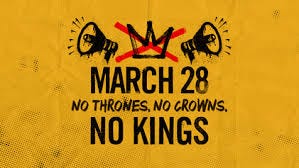
Join me and millions of Americans on March 28, 2026, as we tell this government that we will not be sidelined. Find an event near you at No Kings.
Hi again, Andrea. I just received an email today about a series of SCORE webinars, so the program must still be operating at some level.
I also turned to a SCORE mentor when I retired in 2024 and started my consultancy practice. My mentor was critical to the successful launch of my small business, and I was not aware that this service suffered in the Trump cuts. Short-sightedness seems to be the guiding principle behind this administration.